True Security Gear is reader-supported. When you buy through links on our site, we may earn an affiliate commission. This doesn't affect our verdicts.
Between 8 January and 20 August 2026 the Consumer Product Safety Commission announced 398 recalls. We pulled all of them from the agency’s own web service and read what each one actually says went wrong. In 229 cases the answer was not that the product broke. It was that the product had never been legal to sell.
Our take
Fifty-seven percent of this year’s recalls were not products that broke. They were products that failed a rule they had to meet before they were allowed to ship, and 212 of them were pulled before anyone reported being hurt. Read a certification sticker as the seller’s claim, not as evidence that a test happened.
Two different events, one word
Every recall notice looks the same. Same headline shape, same instruction to stop using the product immediately, same paragraph about contacting the company for a refund. Underneath that uniform surface sit two events with almost nothing in common.
The first is a defect. A product was designed against the rules that apply to it, built to that design, and then something failed. Bolts on attic stairway ladders break during use. A rear brake caliper cracks. A refrigerator’s internal wiring shorts and ignites. Nobody intended any of it, and the recall is the system working roughly as advertised.
The second is non-compliance. The product did not meet the rule on the day it shipped. A bicycle helmet that fails impact attenuation testing is not a helmet that went bad in the field. It is an object that was sold as a helmet while failing the test that decides what a helmet is. The CPSC notice for that case reads, in its own words, that the helmets violate the mandatory safety standard for bicycle helmets.
Those two categories deserve different reactions from a buyer, and the notices give you no help telling them apart at a glance. So we sorted all 398.
229 of 398
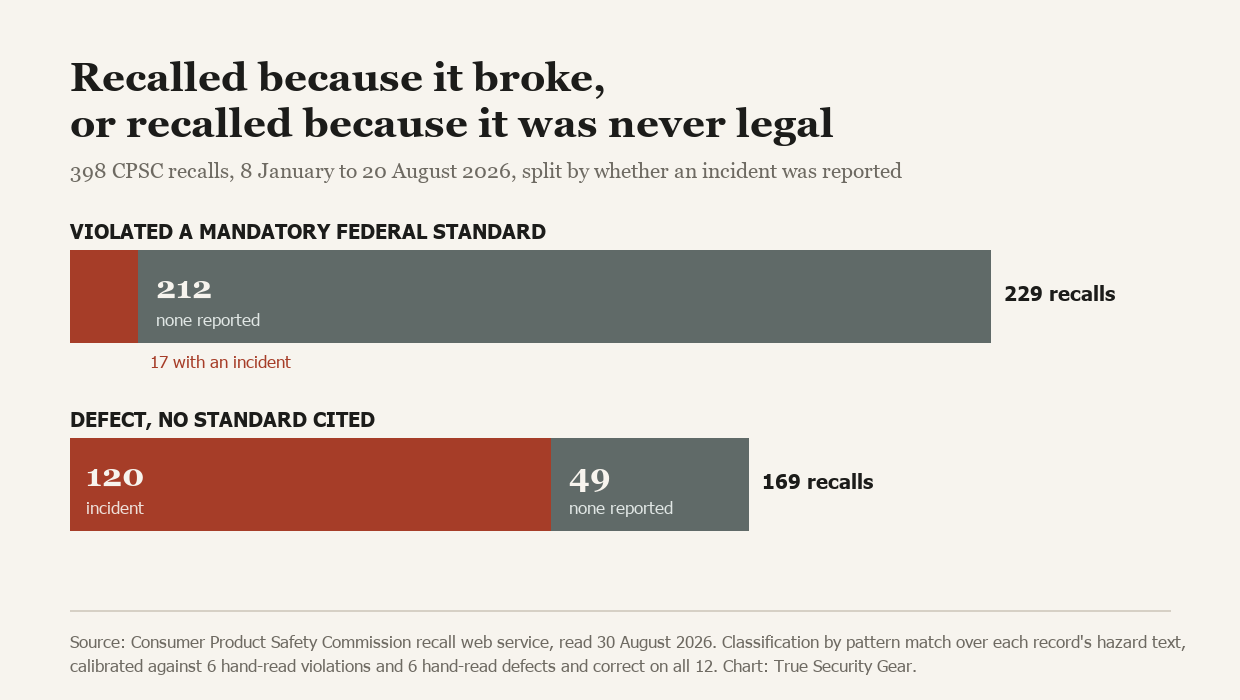
229 recalls cite a violation of a mandatory federal standard, or of a named federal law that makes the sale illegal in itself: the Poison Prevention Packaging Act, the Virginia Graeme Baker Pool and Spa Safety Act, the flammability rules for children’s sleepwear, the button cell battery rule. The remaining 169 describe a failure without invoking any standard.
Fifty-seven percent, then. And it holds month after month rather than coming from one enforcement blitz: 32 of 50 in January, 44 of 62 in February, 14 of 29 in March, 39 of 75 in April, 23 of 41 in May, 26 of 44 in June, 27 of 55 in July, 24 of 42 through 20 August. The low month is March at 48 percent and the high is February at 71 percent.
The half that nobody got hurt by
Here is where the two piles separate hardest, and it is the finding that changed how we read the rest.
Of the 229 non-compliance recalls, 212 report no incident at all. The injuries field reads “None reported”. Of the 169 defect recalls, 120 report at least one incident: fires, ingestions, falls, hospital visits, in several cases deaths.
Read that inversion slowly. A defect is usually discovered because it hurt somebody, and the recall follows the injury. Non-compliance is usually discovered because someone tested a sample, and the recall arrives before anyone is hurt. Those 212 recalls are the enforcement system catching products that had not yet had the chance to do their damage.
Which is genuinely good news about the process and terrible news about the supply. Two hundred and twelve product lines reached American buyers, sat in homes for months, and were pulled only when a laboratory got hold of one. Nothing in that sequence depends on the product being safe. It depends on a sample being tested.
Where they were sold
The recall record includes a free-text sentence describing where the product was sold and for how long. Grepping it for retailer names gives a rough but readable picture.
234 of the 398 notices name Amazon.com. Walmart appears in 46, Target in 19, Costco in 7, Temu in 8, eBay and Etsy in 4 each, Shein in 3, TikTok Shop in 2, AliExpress in 1. Among the 229 non-compliance recalls specifically, 165 name Amazon.
Two cautions on that number before anyone quotes it. The field says where the product was sold, so a recall naming Amazon is a recall whose product was available there, not a recall of an Amazon product or a claim about Amazon’s share of anything. And Amazon’s size guarantees it appears more often than smaller channels regardless of how well it screens. What the figure supports is narrower and still worth knowing: if you buy safety equipment on a marketplace, the products in this dataset were mostly within reach. That includes the cheap end of categories we cover, such as clip-on personal alarms, where dozens of near-identical listings share one factory.
Country of manufacture points the same way. 322 of the 398 recalls list China, and 206 of those 322 are non-compliance rather than defect. Of the 23 recalls listing the United States, 8 are non-compliance. The sample is far too lopsided to support a comparison between countries, and we are not making one. It does say that the non-compliance problem lives overwhelmingly in imported goods.
Twenty bed rails
One product category accounts for a cluster large enough to see from a distance. Between 8 January and 6 August the agency recalled adult portable bed rails twenty times. Nineteen of the twenty cite the same mandatory standard, and in almost identical language: users can become entrapped within the rail or between the rail and the mattress. Nineteen of the twenty were sold on Amazon.
The brand names are all different. Liuqibax, MNIENT, Noerishia, Moodooy, Hopelight, Nimood, Svnntaa, Easymake, ELENKER, Sangohe, MPINOI, Vive Health, Beloems, Fortemotus, Agrish, YOLAAH. Twenty listings, twenty sellers, one failure mode, seven months.
A single recalled bed rail is a company that got something wrong. Twenty of them failing the same clause is a category where meeting the standard is the exception, and where the brand name on the box tells a buyer nothing at all, because the name changes and the product does not.
Button cell batteries produce a second cluster of similar shape: 40 of the 229 involve coin or button cells accessible to a child, spread across the entire period from 8 January to 20 August rather than bunched. Clothing storage furniture produces a third, 23 recalls, every single one for non-compliance.
What this does to a certification claim
This site writes about safety equipment, so the part that matters here is what the numbers do to a product page.
Ten of the 229 non-compliance recalls involve helmets. In each, the listing said the helmet met the federal bicycle helmet standard, and the sticker inside said so too, and the laboratory found otherwise. The certification mark is a manufacturer’s assertion. It is not a receipt from a test. The same gap sits under every grade printed on a lock: an ANSI grade stamped on a deadbolt is a claim about which test series the maker says the lock passed.
That is not an argument for ignoring certification marks, which remain the only signal most listings carry. It is an argument against treating one as proof. The practical version, for gear where failure has real consequences: prefer a brand that has existed under the same name long enough to be sued, check the CPSC recall database for the category before ordering rather than for the specific model after, and treat a helmet, a bed rail or a smoke alarm sold under a name that returns nothing outside its own marketplace listing as untested until shown otherwise.
We do not buy or physically test the products written about here, and this article is no exception. What follows is a reading of a public federal dataset, which is a different kind of evidence and worth saying plainly.
How long the product stayed on the shelf
The retailer sentence usually ends with the month sales stopped. That is readable on 363 of the 398 records, and comparing it to the recall date gives a rough lag.
The median gap is 110 days between the last month of sale and the recall announcement. Four recalls cover products still selling in the month the recall published or later. Eight cover products whose sales ended more than two years earlier, the longest being a Petzl ice axe recall issued 1,486 days after the last sale.
Three and a half months of median lag is the window that matters to a buyer. It is also the argument for checking the database yourself before ordering anything in a category where failure is expensive, a home safe among them. It is the period in which the product is known to be defective or non-compliant somewhere in the process, and still purchasable.
How this was counted
The data came from the CPSC recall web service on 30 August 2026, filtered to recalls dated from 8 January 2026, returning 398 records. Anyone can query the same endpoint and get the same 398.
The classification is a pattern match over the hazard text and description of each record, looking for a violation of a standard or of a named federal statute. A pattern match is exactly the instrument that returns a confident wrong number, so it was calibrated before it was trusted, against six records read by hand and known to be non-compliance and six read by hand and known to be plain defects. The first version of the pattern got 3 of the 6 positives wrong: it missed “violate the mandatory safety standard for bicycle helmets” because the wording placed an extra word where the pattern did not expect one. The version used here scores 6 of 6 on both sides. As a check in the other direction, of the 169 records it classified as defects, zero contain the words “standard”, “regulation” or “compliance” anywhere in their hazard text.
Two limitations are worth stating. The structured HazardType field is empty on all 398 records, and Products[].Type and CategoryID are empty too, so every classification here runs on free text rather than on the agency’s own taxonomy. And two records carry hazard text belonging to a different recall entirely: number 26565, a lithium-ion vaporizer, is described with a hazard paragraph about children’s pajama sets, and number 26428, a pet laser toy, is described with one about a Montessori teething toy. Both were read individually and both are counted as non-compliance because their own titles say so, but they are a reminder that the source is edited by people.
Figures on retailers and on country of manufacture come from free-text and list fields that recall notices are not required to fill consistently, so read them as the shape of the dataset rather than as a census.
Who checked this
True Security Gear does not run a test lab and does not take units apart. One half of the work is documents: manufacturer specs, certifications, and seller claims checked against the paperwork. The other half is the record owners leave behind, in verified-buyer reviews, owner forums, and warranty complaints. Where that evidence is thin we say it is thin, rather than filling the gap with an adjective. The criteria are on How we evaluate.
Google lets you pick which sites come up first in your own results.