True Security Gear is reader-supported. When you buy through links on our site, we may earn an affiliate commission. This doesn't affect our verdicts.
Plug major appliances straight into the wall, never into an extension cord. Use cords only for temporary needs, replace any that are cracked or loose, keep them out from under rugs, and do not overload outlets or strips. If you need a strip, choose one with internal overload protection.
Why a cord is not a permanent fix
The U.S. Fire Administration estimates that 2021 saw 24,200 residential electrical fires, with 295 deaths, 900 injuries and over $1.2 billion in property loss. Those figures cover all electrical causes, not only cords, so they say little about extension cords specifically.
For cords, the Consumer Product Safety Commission has an older figure. A CPSC safety alert dated May 1, 1990 said extension cords were involved in about 4,600 residential fires a year, with 70 deaths and 230 injuries, plus 2,200 injuries from shock. That is 1990 data and should be read as such. The advice in that alert still lines up with what USFA and NFPA say today.
Appliances go in the wall
USFA, NFPA and the USFA electrical safety card agree on the first rule. Major appliances such as refrigerators, dryers and window air conditioners should be plugged directly into a wall outlet. USFA says never to use an extension cord with a major appliance. NFPA’s Educational Messages Desk Reference makes the same point for window air conditioners.
USFA also says kitchen appliances should not run on extension cords. Unplug small appliances when you are not using them. Look over each cord you use for cracks, damage or a loose plug, since those are the defects USFA says to replace.
What temporary means
NFPA’s Desk Reference says extension cords are for temporary use only. If you keep reaching for one in the same spot, that is a sign the room needs another outlet. The Desk Reference says a licensed electrician can add circuits or outlets, and USFA says electrical work should be done by a qualified electrician.
Choosing a cord
CPSC’s 1990 alert gives the buying advice that is still the most specific.
- Look for a cord with a label from an independent testing laboratory.
- Check the gauge. The alert recommends #16 AWG or lower, where a lower number means a thicker wire.
- Use a 3-wire cord for an appliance with a 3-prong plug.
- Do not exceed the wattage rating printed on the cord.
- Use outdoor-rated cords outdoors, and plug them into a GFCI outlet.
NFPA also says outdoor cords must be rated for outdoor use.
Plugs and outlets
Never remove the third prong, and never force a three-prong plug into a two-slot outlet, as USFA and CPSC both warn. Push plugs in fully. Pull on the plug and not on the cord when you disconnect, which CPSC lists. Do not overload outlets.
Where cords should not go
USFA says to avoid pinching cords under carpet or rugs. Ready.gov and CPSC both say not to run cords under rugs.
For a cord that has gone bad, USFA says to replace cracked, damaged or loose cords. It does not say to repair them. NFPA’s number for the same rule is 12.1.11 in the Desk Reference.
Power strips and surge protectors
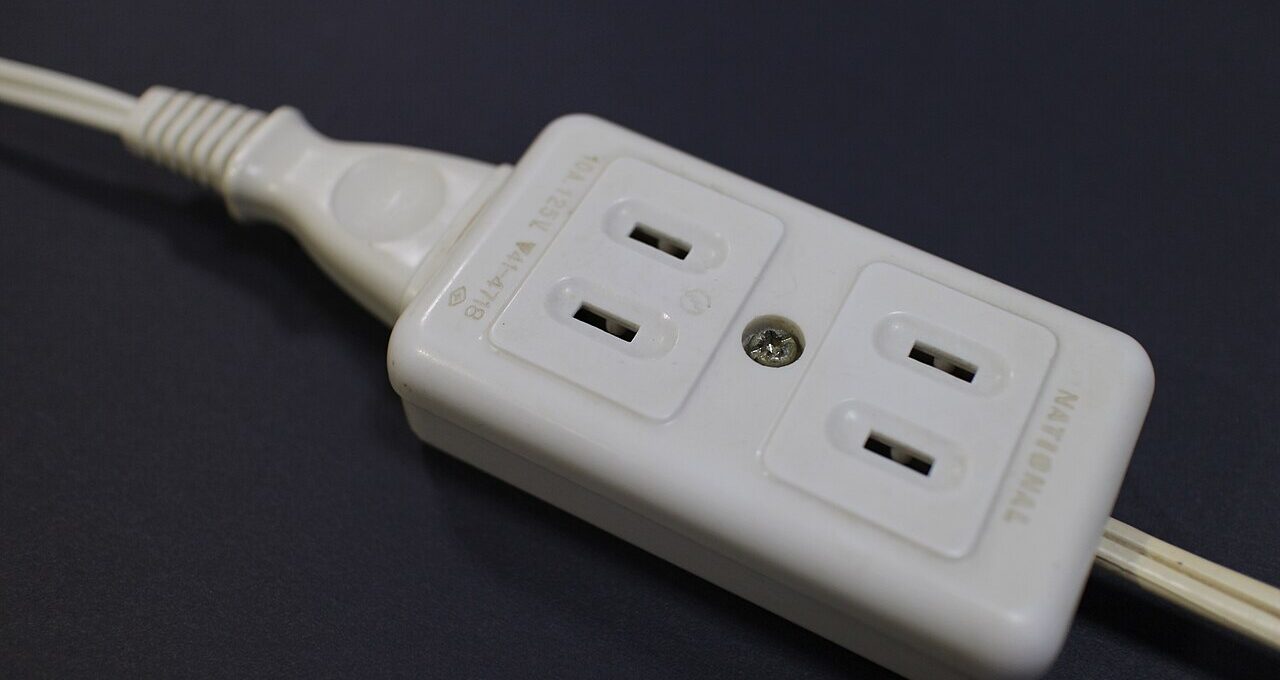
A power strip does not create new capacity, and USFA warns against overloading it. The agency recommends strips with internal overload protection. NFPA’s Desk Reference adds that surge protectors and power strips should be listed by a nationally recognized testing laboratory and have internal overload protection.
The sources reviewed here do not give a wattage rule for how many devices a strip can take. Look at the rating on the strip and on each device, and keep high-draw appliances off it. CPSC’s wattage warning applies to cords in the same way.
Holiday lights are a special case
CPSC’s holiday safety page says never to string together more than three sets of incandescent lights. USFA tells you to follow the strand limit in the manufacturer’s instructions. The cord rules still apply: no covered cords and no overloaded outlets.
A quick check
| Look at | Act if you find |
|---|---|
| Every cord you use daily | Cracks, damage or a loose plug: replace it |
| Anything under a rug | Pull it out |
| Refrigerators, dryers, window air conditioners | Plugged into an extension cord: move the plug to the wall |
| Power strips | No overload protection or too many devices: replace or reduce |
| A cord you rely on in the same place | Ask an electrician about another outlet |
Sources
- U.S. Fire Administration, Appliance and electrical fire prevention, read November 2026
- U.S. Fire Administration, Electrical fire safety card (PDF), read November 2026
- U.S. Consumer Product Safety Commission, Extension cords safety alert, May 1, 1990, read November 2026
- U.S. Consumer Product Safety Commission, Holiday safety, read November 2026
- NFPA, Educational Messages Desk Reference, 2026 edition (PDF), read November 2026
- Ready.gov, Home fires, read November 2026
FAQ
Can I plug a refrigerator into an extension cord?
No. USFA says never to use an extension cord with a major appliance.
How long can an extension cord stay in use?
NFPA says extension cords are for temporary use only.
Is it safe to run a cord under a rug?
No. USFA, Ready.gov and CPSC all advise against it.
What should a power strip have?
Internal overload protection, and a listing from a nationally recognized testing laboratory, per NFPA. USFA also recommends overload protection.
Can I repair a damaged cord?
USFA says to replace cracked, damaged or loose cords and not to repair them.
Who checked this
True Security Gear does not run a test lab and does not take units apart. One half of the work is documents: manufacturer specs, certifications, and seller claims checked against the paperwork. The other half is the record owners leave behind, in verified-buyer reviews, owner forums, and warranty complaints. Where that evidence is thin we say it is thin, rather than filling the gap with an adjective. The criteria are on How we evaluate.
Google lets you pick which sites come up first in your own results.