True Security Gear is reader-supported. When you buy through links on our site, we may earn an affiliate commission. This doesn't affect our verdicts.
Put a smoke alarm inside every bedroom, outside each sleeping area, and on every level of the home, including the basement. That is the placement rule from the U.S. Fire Administration and the NFPA tip sheet, which adds that most homes do not have this level of protection. The rest of this article covers the spacing details from the NFPA desk reference and the places an alarm should not go.
The baseline: where every home needs one
NFPA says to install alarms in any room where someone sleeps, outside each separate sleeping area (a hallway, for example), and on every level including the basement. The USFA phrases it as inside and outside each bedroom and sleeping area and on every level, and notes that a closed door may slow the spread of smoke, heat and fire. Larger homes may need more alarms than that minimum, according to the USFA infographic. On a split-level home, NFPA says to install alarms near the stairs between levels and in areas that protect all sleeping spaces.
Interconnection matters here. NFPA says to interconnect all smoke alarms so that when one sounds, they all sound, and that this is especially important if you sleep with the bedroom doors closed. Hard-wired alarms can be interconnected by a licensed electrician, or you can use battery-powered wireless alarms that link to each other. The USFA adds that only qualified electricians should install hardwired alarms.
Height and position on walls and ceilings
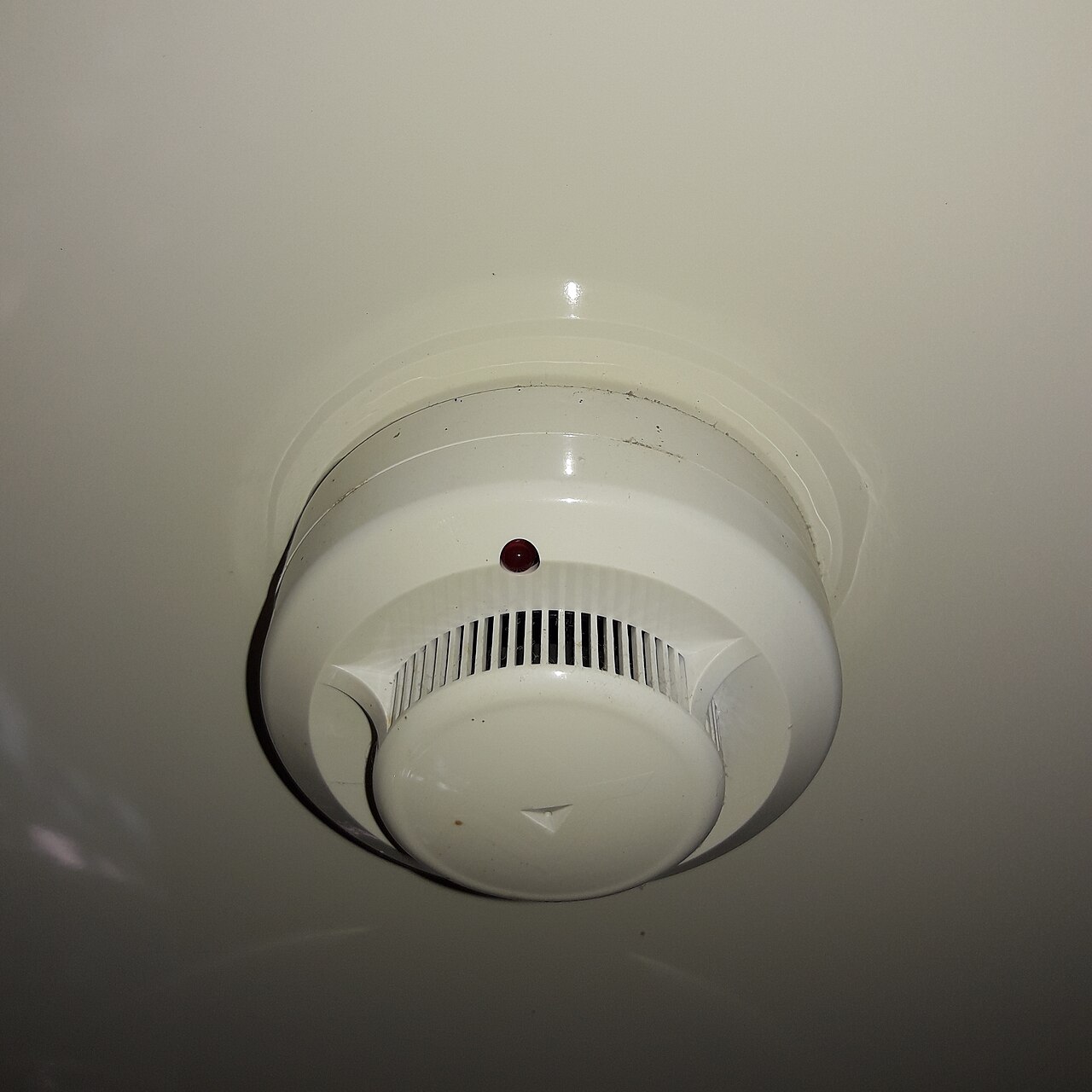
NFPA says an alarm belongs on the ceiling or high on a wall. The details for each situation:
| Situation | NFPA placement rule |
|---|---|
| Ceiling mount | On the ceiling or high on a wall. |
| Wall mount | At least 4 inches from a corner, and between 4 and 12 inches from the ceiling. |
| Sloped ceiling | At the highest point, or within 1 foot of it. |
| Stairways | Where rising smoke will not be blocked by doors or other obstructions. In basements, near the entry to the stairs. |
| Split-level homes | Near the stairs between levels, and where all sleeping spaces are protected. |
Both agencies also say to follow the instructions that come with the alarm. Where a manufacturer’s rule and a general rule differ, the manual for that specific unit is the one to follow.
Keeping away from kitchens and bathrooms
Nuisance alarms are a reason people give up on an alarm, so spacing from cooking and steam is not a minor detail. NFPA says to install smoke alarms at least 10 feet (3 meters) from a cooking appliance. Multi-criteria alarms, which use more than one sensor to tell real fires from steam, cooking fumes or dust, can be installed as close as 6 feet (2 meters) when the manufacturer’s instructions allow it. NFPA also says to keep alarms at least 3 feet (1 meter) from bathrooms with showers or tubs.
For the alarm that goes off anyway, the USFA says never to take the battery out. Open a window or door and press the hush button, wave a towel at the alarm, or move the alarm several feet farther from the kitchen or bathroom. The USFA calls disabling an alarm or removing its battery a deadly mistake.
Places an alarm should not go
NFPA’s desk reference lists several locations to avoid.
- In direct airflow from vents or registers, and within 3 feet of air vents or ceiling fan blades.
- In garages, and in unfinished attics that have no heat or air conditioning.
- Anywhere temperatures fall below 40 degrees F or rise above 100 degrees F.
The USFA gives a reason for the garage exclusion: smoke alarms are not required or designed for use in garages, where changes in temperature and humidity, dust, fumes and insects can set them off. Its separate guidance on heat alarms covers detection in an attached garage, and our article on garage door security deals with the other risk to that space.
Which type of alarm to buy
NFPA says an ionization alarm is more responsive to flaming fires and a photoelectric alarm is more responsive to smoldering fires, and recommends using both types or dual-sensor alarms. The USFA gives the same advice, reasoning that nobody can predict which type of fire will start in their home. Whatever the type, NFPA says to buy an alarm listed by a nationally recognized testing laboratory. For people who are deaf or hard of hearing, NFPA describes strobe lights and bed shakers triggered by the sound of a standard alarm, and low-frequency alarms for mild to severe hearing loss.
Maintenance, renters, and what to do when it sounds
A well-placed alarm still has to work. NFPA says to test alarms at least once a month, change replaceable batteries at least once a year, and replace the whole alarm 10 years from the manufacture date, printed on the outside or back of the unit.
NFPA says all rental housing should have working smoke alarms, and that tenants should contact the landlord, property manager, or fire department if they are missing. If you want to add a battery-operated alarm in a bedroom yourself, check your lease first. Our guide to apartment security tips for renters covers how to handle changes in a rental.
When an alarm sounds for real, the USFA says to get outside and stay outside, go to your outside meeting place, and call the fire department from a cellphone or a neighbor’s phone. Stay out until the fire department says it is safe.
Our take
Count your sleeping rooms, hallways, and floors, then check that each one has an alarm in the right spot: on the ceiling or high on the wall, away from the kitchen and bathroom, away from vents, and not in the garage or an unheated attic. Fix the missing ones first and the spacing second. A well-placed alarm in a hallway outside the bedrooms is worth more than a perfectly measured one in a room nobody sleeps in.
Common questions about smoke alarm placement
Do I need a smoke alarm in every bedroom?
Yes. NFPA and the USFA say to install alarms inside every sleeping room, outside each sleeping area, and on every level of the home.
How far should a smoke alarm be from the kitchen?
NFPA says at least 10 feet from a cooking appliance. Multi-criteria alarms can be as close as 6 feet when the manufacturer allows it.
Can I put a smoke alarm in the garage?
NFPA says not to install one in a garage or an unfinished attic without heat or air conditioning, and the USFA says smoke alarms are not required or designed for garages.
Where does a smoke alarm go on a wall?
At least 4 inches from a corner and between 4 and 12 inches from the ceiling, per NFPA.
Should smoke alarms be linked together?
Yes. NFPA says to interconnect them so all sound when one does, which matters most if you sleep with bedroom doors closed.
Who checked this
True Security Gear does not run a test lab and does not take units apart. One half of the work is documents: manufacturer specs, certifications, and seller claims checked against the paperwork. The other half is the record owners leave behind, in verified-buyer reviews, owner forums, and warranty complaints. Where that evidence is thin we say it is thin, rather than filling the gap with an adjective. The criteria are on How we evaluate.
Google lets you pick which sites come up first in your own results.