True Security Gear is reader-supported. When you buy through links on our site, we may earn an affiliate commission. This doesn't affect our verdicts.
Short answer: A bigger piece count does not make a better first aid kit. What matters is that you know what is in it, that it is where you can find it, and that it matches the people in your house. Two real kits are compared below against the Red Cross list for a family of four, so you can see what each one covers and what you still have to add.
True Security Gear is reader-supported. When you buy through links on our site, we may earn an affiliate commission. This doesn’t affect our verdicts. See our affiliate disclosure.
First aid kit listings love big numbers. 300 pieces, 180 pieces. Open one and a lot of those numbers turn out to be adhesive bandages in a dozen sizes. That is not useless, it is just not the same as 300 different tools. Both listings below are honest about that in their own way.
Our take
For a home or car, a kit you will actually open beats one you admire. The soft case travels and fits in a seat pocket. The hard case stacks on a shelf and protects the contents. Whichever you buy, empty it onto a table once, hold it up against the Red Cross list below, learn where everything is, and add what your household needs, such as prescription items and a spare pair of reading glasses.
What the Red Cross says a kit should hold
The American Red Cross says you can buy a first aid kit or put one together, and either way you should make sure it has the items you may need. Its page on making a first aid kit lists what it recommends for a family of four:
- 2 absorbent compress dressings (5 x 9 inches)
- 25 adhesive bandages in assorted sizes
- 1 adhesive cloth tape (10 yards x 1 inch)
- 5 antibiotic ointment packets (about 1 gram each)
- 5 antiseptic wipe packets
- 2 packets of aspirin (81 mg each)
- 1 emergency blanket
- 1 breathing barrier with a one-way valve
- 1 instant cold compress
- 2 pairs of nonlatex gloves (large)
- 2 hydrocortisone ointment packets (about 1 gram each)
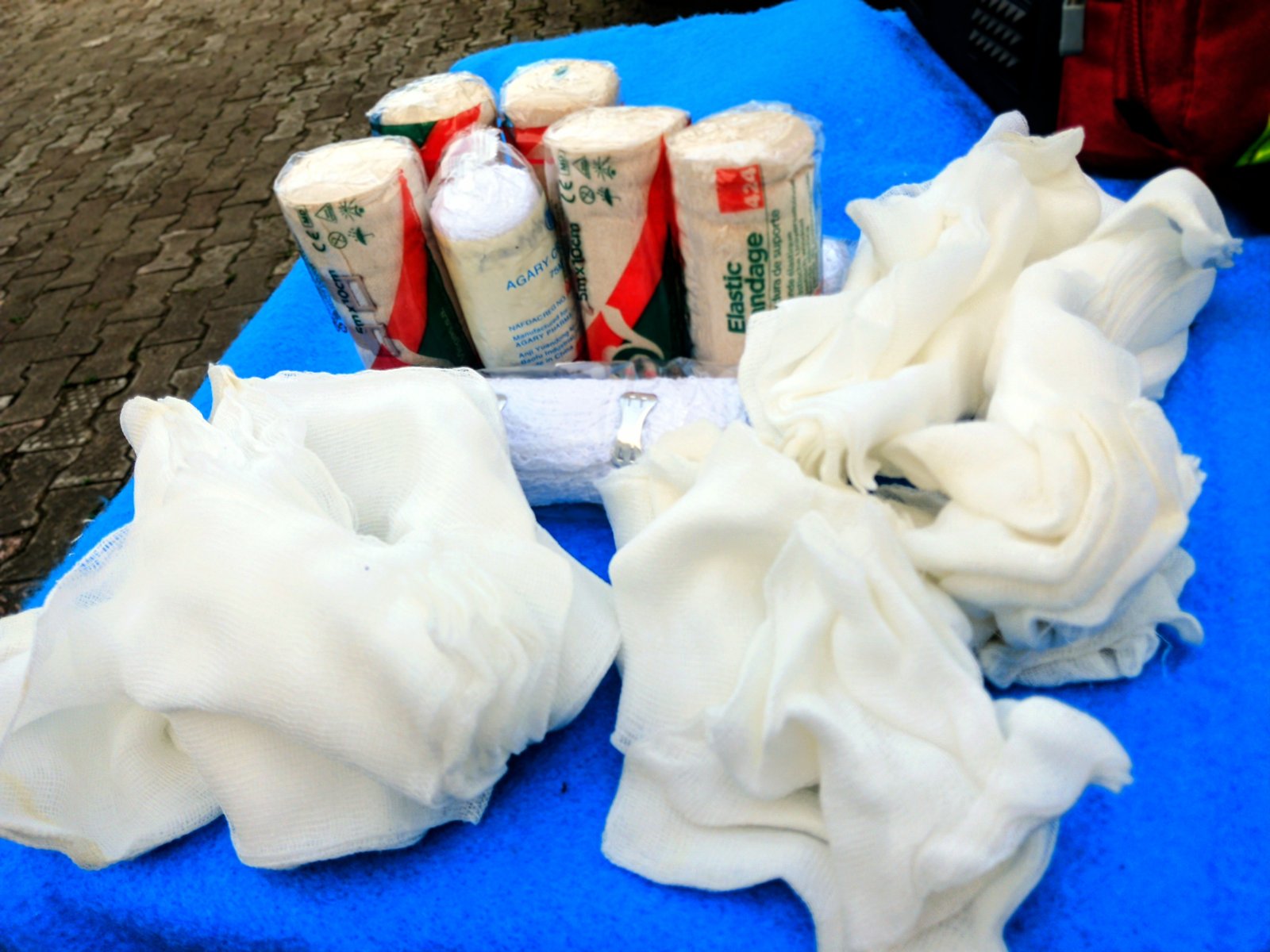
- 1 roller bandage, 3 inches wide, and 1 roller bandage, 4 inches wide
- 5 sterile gauze pads (3 x 3 inches) and 5 sterile gauze pads (4 x 4 inches)
- An oral thermometer, non-mercury and nonglass
- 2 triangular bandages
- Tweezers
- Emergency first aid instructions
The same page tells you to add personal items such as medications and emergency phone numbers, or anything else your health-care provider suggests. It also tells you to keep a kit in your home and in your car, to carry one with you or know where one is, to find out where the kits are at work, and to check expiration dates and replace anything used or out of date.
Separately, the Red Cross survival kit supplies page lists a first aid kit among the basics, together with a seven-day supply of medications, a flashlight, a battery-powered or hand-crank radio, extra batteries and a multi-purpose tool.
That list is a good yardstick. It is short enough to hold a store kit up against, and it shows how little of a big piece count is dressings and tools. Neither listing below publishes a full contents list in the bullets we read, so the check is yours to make when the box arrives.
The two kits
M2 BASICS 300 Piece First Aid Kit
A soft-case kit that travels well.
- The title counts 300 pieces. The listing says that is 40 unique items.
- Soft carrying case.
- Includes a CPR mask, a cold pack and an emergency blanket, per the listing.
Be Smart Get Prepared 180 Piece First Aid Kit
A hard case that protects the contents on a shelf.
- Hard case, about 8 x 10 x 3 inches.
- 180 pieces.
- The listing says it meets FDA regulatory standards as a medical device. We cannot confirm that claim, so read the listing yourself before relying on it.
Side by side
| Kit | Case | Count (listing) | Good for |
|---|---|---|---|
| M2 Basics | Soft | 300 pieces, 40 unique items | Car, travel, a bag |
| Be Smart Get Prepared | Hard, 8 x 10 x 3 in | 180 pieces | A shelf at home |
How to choose between them
Start with where the kit will live. A car kit is opened rarely and abused constantly, so a soft case that fits a seat pocket or the back of a seat is the practical pick. A home kit sits on a shelf, gets rummaged through by tired people at night, and benefits from a hard shell that keeps the contents flat and dry.
Then think about who is in the house. A family with young children needs different dosing items than a pair of retirees. Someone on a daily medication needs a labeled backup supply. A store kit is written for nobody in particular, and that is the whole reason the Red Cross list ends with personal items.
Last, look at what the kit is missing when you hold it up against the list. If you are short on gauze pads, roller bandage or tape, you can fill that gap for a few dollars. If the kit has plenty of small adhesive bandages and little else, that tells you what the piece count is made of.
What to add yourself
Whatever you choose, adjust it. Add your own medications in labeled containers and check expiry dates twice a year. If someone in the house has an allergy, a chronic condition or a child’s dosing needs, a generic kit won’t cover it. The Red Cross asks for a seven-day supply of medication in the emergency kit, which is a household task no store kit does for you.
Put a card in the lid with phone numbers and the nearest hospital. Keep a second, smaller kit in the car; our home safety for people living alone guide covers the other household basics worth setting up next.
Where to keep it
A first aid kit works only if people can reach it fast. The kitchen is a good place for a home kit, because most small injuries happen there: a cut, a burn, a splinter. A bathroom cabinet is warm and damp, which is hard on adhesive and on any medication you add. If the kit lives in a closet, put a label on the door.
A car kit has the opposite problem. Heat in summer and cold in winter wear on bandages and ointments. Look at the contents when the seasons change, and replace anything that has gone sticky, cracked or stiff. A soft case in a seat pocket will get more use than a hard case in the trunk, which you only open in trouble.
Show everyone in the house where it is. Children old enough to find it can also be old enough to raid it, so decide what you want them to touch and keep scissors and medications up high.
Reading a piece count
Take the M2 Basics title. It says 300 pieces, and the listing says 40 unique items. That is a perfectly honest way to count, as long as you understand the difference. A hundred adhesive bandages are useful, but they will not help with a deep cut, a sprain or a sting.
The better question is what situations the kit covers. Look for items to clean a wound, to cover it, to hold a dressing in place and to cut tape or cloth. The Red Cross list does this in plain terms: antiseptic wipes and ointment to clean, gauze pads and compress dressings to cover, roller bandage and tape to hold, a triangular bandage for a sling. Then look for what is missing for your household. If someone has a bee allergy, the kit cannot hold what they need; that is a conversation with a doctor.
The Be Smart listing mentions an FDA claim. We could not confirm it, and a regulatory statement on a product page is only as good as the company behind it. If that matters to you, ask the seller or read the label on the box when it arrives.
Common mistakes
The first is buying the kit and never opening it. When something goes wrong, nobody wants to learn where the tweezers are by tipping everything on the floor.
The second is letting it go stale. Ointment packets dry out, adhesive lets go, and the aspirin you added three years ago has a date on it. The Red Cross says to check the kit regularly and replace anything used or out of date.
The third is stripping it for other uses. The scissors walk off to the craft drawer and the tape ends up on a package. Put a note in the lid saying what is missing, and replace it the same week.
The fourth is treating the kit as a substitute for knowing what to do. A breathing barrier with a one-way valve is useful only to someone who has practiced rescue breathing. The Red Cross teaches first aid and CPR, and a short class does more than any extra piece in the box.
A five-minute check
When the kit arrives, open it on a table. Read each label. Throw out anything that looks damaged. Put what you use most on top. Add a small notebook and a pen, so whoever uses the kit can write down what happened and when. Then close it and put it where it belongs.
Twice a year, on the same days you test the smoke alarms, open it again. Replace what has expired, restock what you used, and make sure the phone numbers on the card still work.
Questions people ask
Is a higher piece count better?
Not by itself. The M2 Basics listing counts 300 pieces from 40 unique items, which shows how counts work.
Soft case or hard case?
Soft cases pack easier. Hard cases protect better on a shelf.
What does the Red Cross say a family kit needs?
Its list for a family of four runs from compress dressings, bandages, tape and gauze to antiseptic wipes, ointments, gloves, a thermometer, tweezers, triangular bandages and first aid instructions. The full list is above.
How often should I check it?
Twice a year works. Replace anything used or past its date.
Should I keep one in the car?
Yes. The Red Cross recommends a kit in your home and in your car. Check the car one when the seasons change, since heat and cold wear on bandages and ointments.
Does a kit replace first aid training?
No. A CPR mask is useful only if you know how to use it. The Red Cross offers courses.
Sources
Nonprofit pages read on 2026-11-05. Product details come from the Amazon listings linked above and were not verified by us.
- American Red Cross, Make a First Aid Kit
- American Red Cross, Survival Kit Supplies
Who checked this
True Security Gear does not run a test lab and does not take units apart. One half of the work is documents: manufacturer specs, certifications, and seller claims checked against the paperwork. The other half is the record owners leave behind, in verified-buyer reviews, owner forums, and warranty complaints. Where that evidence is thin we say it is thin, rather than filling the gap with an adjective. The criteria are on How we evaluate.
Google lets you pick which sites come up first in your own results.