True Security Gear is reader-supported. When you buy through links on our site, we may earn an affiliate commission. This doesn't affect our verdicts.
Short answer: For a power outage you want one lantern that lights a room, one flashlight with a real beam, and spare batteries for both. Ready.gov asks for a flashlight for every household member. Below are three real lights, and the spec each listing gives you to compare them.
True Security Gear is reader-supported. When you buy through links on our site, we may earn an affiliate commission. This doesn’t affect our verdicts. See our affiliate disclosure.
Candles are the default for a lot of households when the lights go out, and they are also a fire risk we cover elsewhere on this site. Battery lights cost little, and the only real decision is what kind of light you need: area light to move around a room, or a beam to check the breaker panel or the yard.
Our take
Get a lantern for the room and a flashlight for the task, then spend five minutes putting fresh batteries in both. The lantern is the one that replaces candles. The flashlight is the one you will actually pick up first, so keep it somewhere you can find in the dark.
What Ready.gov says to plan for
Ready.gov’s power outage page says to have flashlights for every household member and to plan for a portable charger or power bank. Its winter weather page adds extra batteries for radios and flashlights. It also says a refrigerator keeps food cold for about four hours and a full freezer for about 48 hours if the doors stay closed.
Lighting is the easy part of that list, which is why it is the part people skip. It is also the part that keeps you from tripping on the basement stairs.
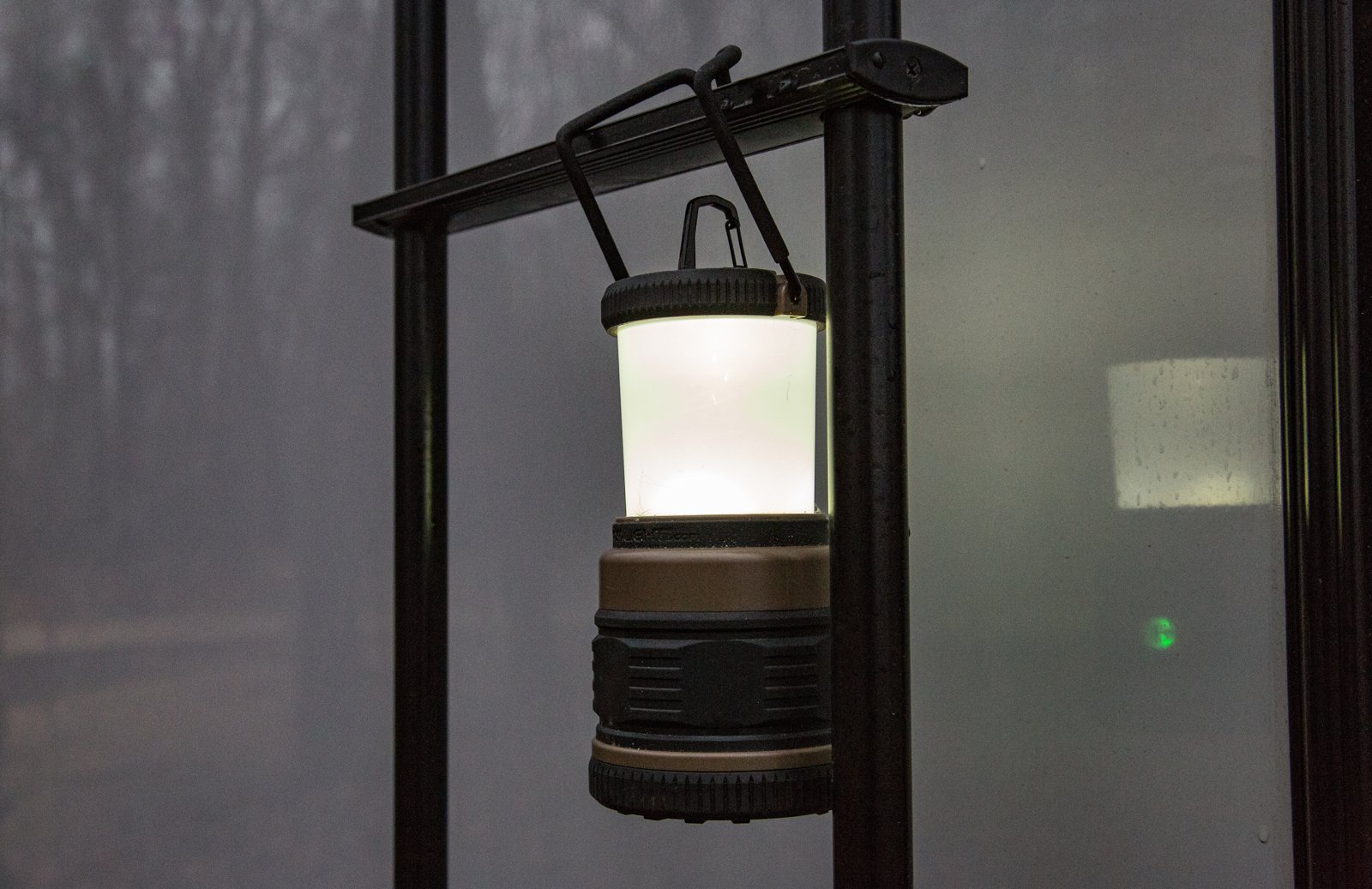
The room light
Energizer WeatheReady PRO-360 LED Camping Lantern
The better fit if you want a lantern built around runtime.
- Listing claims 500 lumens on high with a 150 hour runtime. The listing does not say how those two numbers relate, so read the 150 hours as the manufacturer’s best case.
- IPX4 water resistant, impact resistant up to 1 meter, shatterproof lens.
- Battery-operated, per the listing.
Coleman 1000L LED Lantern with Enhanced Battery Protection
The brighter on paper, with a feature aimed at batteries that sit for years.
- Up to 1000 lumens, beam distance up to 16 meters, four modes.
- BatteryGuard technology, which the listing says preserves battery life and prevents corrosion.
- Impact resistant to 2 meters, with a 3-year warranty, per the listing.
Lumens are a count of total light output, and a 1000-lumen lantern in a small bedroom is more than you want at 2 a.m. The mode that matters is the low one, and neither listing gives its brightness or runtime. If you have a choice between brightness and a long low mode, take the long low mode.
The task light
Streamlight 75429 Stinger 800-Lumen Flashlight
A serious handheld that suits a garage or workshop more than a drawer.
- High: 800 lumens, 1.5 hours. Medium: 400 lumens, 2.5 hours. Low: 200 lumens, 5 hours.
- Rechargeable up to 1000 times, per the listing.
- The listing says it includes the rechargeable battery but no charger. Check what comes in the box before assuming you can charge it.
The Stinger is the one item here that depends on an outlet to stay ready. If your outage plan assumes the house stays dark for days, pair it with a power bank and a light that takes standard cells, or choose a smaller light that charges over USB.
Side by side
| Light | Type | Top output (listing) | Watch for |
|---|---|---|---|
| Energizer PRO-360 | Lantern | 500 lumens | 150 h runtime figure has no stated condition |
| Coleman 1000L | Lantern | 1000 lumens | Low-mode output not listed |
| Streamlight Stinger | Handheld | 800 lumens, 1.5 h | No charger included |
A setup that works at 3 a.m.
Put one light in each bedroom, one in the kitchen and one at the main door. Nobody should have to cross a dark room to reach the light that helps them cross the dark room. Keep the handheld on a hook or in a fixed drawer, never loose on a counter where it gets moved.
Test everything now, with the house lit. Switch each light through every mode, and note how dim the low setting looks after a few minutes. Replace anything that flickers. Do this when you change your smoke alarm batteries so it becomes one chore instead of two.
Outage hazards go beyond darkness. Ready.gov says not to heat with a gas stove or oven, and its winter weather page says generators belong outdoors, at least 20 feet from windows, doors and attached garages. Our guide to portable generator placement goes through that in more detail. Ready.gov also says to discard refrigerated medication after more than a day without power unless the label says otherwise, so check the labels on yours in advance.
Power bank, since the lights are only half of it
Ready.gov’s outage page tells you to plan for a portable charger or power bank. Phones are your flashlight backup, your weather feed and your line to the utility. Charge a power bank on the same day you test the lights. We have not picked a model here because we have not verified one for this page.
Batteries are the plan, not an accessory
Ready.gov specifically lists extra batteries. Buy them with the light, store them in the same drawer, and write the date you checked them on a piece of tape. If a lantern takes D cells, a drawer of dead alkaline cells is a more common failure than a broken lantern.
Pair your lights with a carbon monoxide detector with a battery backup. Ready.gov also warns against heating with a gas stove or oven during an outage.
Where the lights live
A light you cannot find is a light you do not own. The usual failure is a lantern in the garage and a flashlight in the junk drawer, both a long walk from the bedroom in the dark. Pick one spot per floor and keep it there. A shelf by the stairs works better than a closet, because the stairs are where an outage hurts most.
Think about who reaches for what. An adult can handle a heavy handheld; a child needs something with one big switch. If an older relative lives with you, test the switch with their hands, not yours. Stiff slide switches and recessed buttons are common on lanterns, and a light that takes two tries to turn on is a light that stays off.
Keep a spare set of batteries taped to the underside of the shelf, not inside the lantern. Cells left in a device for years are the ones that leak. Rotate them into the smoke alarms and the remote controls when you refresh the shelf, and buy new ones for the lights.
Last, decide in advance what the lights are for. A lantern on the kitchen table is for sitting and eating. A flashlight is for walking to the breaker panel. Neither is a reason to relight a candle, and neither is a reason to run a generator in the garage.
Questions people ask
How many flashlights do I need?
Ready.gov says one for every household member. A kid-sized light in each bedroom saves a lot of groping around.
Are lanterns safer than candles?
A battery lantern has no open flame, which removes the main ignition risk.
How long will my fridge stay cold?
Ready.gov says about four hours for a refrigerator and about 48 hours for a full freezer, if you keep the doors closed. It also says to throw out food that has reached 40 degrees or higher.
Do the lumen numbers on these listings hold up?
We have not measured them. They are the manufacturers’ figures as printed on Amazon.
Sources
Government pages read on 2026-11-05. Light output, runtime and impact ratings come from the Amazon listings linked above and were not measured by us.
- Ready.gov, Power Outages
- Ready.gov, Winter Weather
Who checked this
True Security Gear does not run a test lab and does not take units apart. One half of the work is documents: manufacturer specs, certifications, and seller claims checked against the paperwork. The other half is the record owners leave behind, in verified-buyer reviews, owner forums, and warranty complaints. Where that evidence is thin we say it is thin, rather than filling the gap with an adjective. The criteria are on How we evaluate.
Google lets you pick which sites come up first in your own results.