True Security Gear is reader-supported. When you buy through links on our site, we may earn an affiliate commission. This doesn't affect our verdicts.
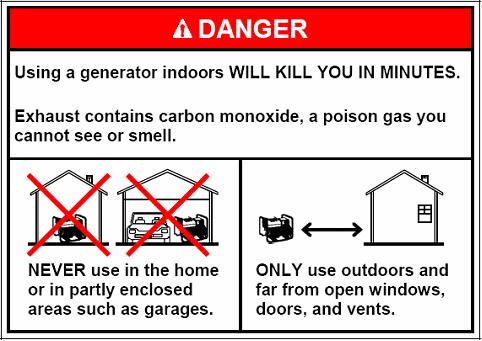
Run a portable generator outdoors only, at least 20 feet from homes and buildings, with the exhaust directed away from windows, doors and vents. That is the Consumer Product Safety Commission’s wording, from a 2026 warning issued ahead of hurricane season. The CPSC also says never to use one inside homes, garages, basements, crawlspaces, sheds or other enclosed areas, even if doors or windows are open.
The rule exists because generator exhaust contains carbon monoxide (CO). The NFPA desk reference lists portable generators among the sources of CO, and the CDC points to generators in its guidance for people coping with power outages.
The distance rule, from three sources
The 20-foot figure appears in all three agencies’ material, with small differences in wording. That agreement is the reason to treat it as settled.
| Source | What it says |
|---|---|
| CPSC | Operate generators outdoors only, at least 20 feet from homes and buildings, with exhaust directed away from windows, doors and vents. |
| NFPA | Use portable generators outdoors at least 20 feet (7 meters) from all doors, windows and vent openings. Measure from the generator to the building. |
| CDC | Keep generators at least 20 feet from doors and windows. Never use them inside the home, garage or carport. |
The NFPA desk reference adds details that people skip. Measure the 20 feet from the generator to the building rather than eyeballing it. Direct the exhaust away from the building. Twenty feet in the wrong direction, with a window open downwind, does not satisfy the intent.
Why the garage and open doors do not help
The most common mistake is the half-measure: the generator goes in the garage with the big door open. NFPA says not to use a generator in an attached garage even with the door open. CPSC says never to use one in homes, garages, basements, crawlspaces, sheds or other enclosed areas even if doors or windows are open. The CDC lists garages and carports as places where it must never run. None of the three leaves an exception for rain, cold, or a short job.
NFPA also says not to stand or sit downwind of generator exhaust, and offers a plain test: if you can smell exhaust, you are inhaling it. The reverse is not a safe test. Carbon monoxide itself cannot be seen, tasted, or smelled, according to NFPA, so a house that smells fine can still contain it.
Detectors indoors are part of the plan
Distance reduces risk. It does not remove it. NFPA says that when you use a portable generator you should have CO alarms in the home, and the CPSC says to install working CO and smoke alarms, battery-operated or with battery backup, on every level and outside sleeping areas, and to test them monthly. This matters during an outage in particular: a plug-in alarm without backup depends on household power, which is the thing that just failed. Our look at what happens to an alarm system when the power goes out explains the same dependency for burglar alarms.
If an alarm sounds while the generator is running, the same instruction applies as for any other CO alarm: go outside to fresh air and call 911, and do not reenter until responders say so. The CPSC fact sheet also warns against trying to find the source of the CO yourself.
What to look for when buying
The CPSC recommends generators certified to the latest PGMA G300-2023 and UL 2201-2023 standards, which include CO safety features. It adds that UL 2201 certified models have reduced CO emissions in addition to the CO shut-off feature. NFPA gives the buying advice in plainer terms: when buying or renting a portable generator, choose one listed by a nationally recognized testing laboratory, and choose one with a CO shut-off safety feature that automatically shuts off the generator when high levels of CO are present around it.
A shut-off feature is a backstop, not permission to shorten the distance. The sources present it as an added layer, and the placement rules apply regardless.
One limit on this article: none of the pages used here covers connecting a generator to a home electrical system, including transfer switches or interlock devices. That is an electrical question with its own safety rules and sources, and it is not covered here.
Other fuels that cause the same problem
The CPSC says never to use charcoal indoors. The CDC says never to use generators, grills, or other gasoline, propane, or charcoal-burning devices inside the home, garage, or carport, and not to use a portable gas stove for heat. The same logic applies: anything that burns fuel makes CO, and it belongs outdoors.
When to call for help
Symptoms do not wait for an alarm. NFPA lists headache, dizziness, weakness, drowsiness, nausea and vomiting, and others, and says that if you have any of these symptoms you should go outside right away and call 911. The CDC says people who are asleep or intoxicated can die without noticing symptoms, which is why a generator should never run near a house where people are sleeping without working alarms inside.
This article covers a health hazard and is general safety information. For anyone feeling ill after exposure, the answer is emergency care, not more reading.
Our take
Three agencies, one number: 20 feet, outdoors, exhaust aimed away from the house. Do not trade that for a garage with the door open. Buy a unit with a CO shut-off feature and a testing laboratory listing, and put battery-backed CO alarms on every level and outside bedrooms before the storm arrives. Leave the electrical hookup question to a source that covers it.
Common questions about generator carbon monoxide safety
How far from the house should a generator be?
At least 20 feet, according to the CPSC, NFPA and CDC, with the exhaust directed away from windows, doors and vents.
Is it safe to run a generator in the garage with the door open?
No. NFPA says not to use a generator in an attached garage even with the door open, and the CPSC says never to run one in a garage or other enclosed area even if doors or windows are open.
Do I still need a CO alarm if the generator is outside?
Yes. NFPA says to have CO alarms in the home when using a portable generator, and the CPSC recommends battery-operated or battery-backed alarms on every level and outside sleeping areas.
What is a CO shut-off feature?
NFPA describes it as a feature that automatically shuts off the generator when high levels of CO are present around it. The CPSC recommends generators certified to PGMA G300-2023 and UL 2201-2023.
What should I do if I feel sick near a running generator?
Go outside right away and call 911, per NFPA. The CDC says to seek emergency medical attention.
Who checked this
True Security Gear does not run a test lab and does not take units apart. One half of the work is documents: manufacturer specs, certifications, and seller claims checked against the paperwork. The other half is the record owners leave behind, in verified-buyer reviews, owner forums, and warranty complaints. Where that evidence is thin we say it is thin, rather than filling the gap with an adjective. The criteria are on How we evaluate.
Google lets you pick which sites come up first in your own results.