True Security Gear is reader-supported. When you buy through links on our site, we may earn an affiliate commission. This doesn't affect our verdicts.
If a carbon monoxide (CO) alarm is sounding, leave the building right now, then call 911 from outside. Both major sources give that order. The Consumer Product Safety Commission says to move outside to fresh air and call emergency services, the fire department or 911. The National Fire Protection Association says to go outside immediately, call 911 once you are out, and stay out until emergency personnel say it is safe to go back in.
Everything else in this article is detail around those two moves. Read it before an alarm goes off, because the middle of the night is a poor time to be working out a plan.
The steps, in order
CPSC and NFPA agree on the core sequence, and CPSC adds details that matter in a crowded house.
- Get everyone outside to fresh air.
- Once outside, call 911, the fire department, or your local emergency number.
- Do a head count. CPSC says to check that all persons are accounted for after you call.
- Stay out. CPSC says not to reenter until emergency responders have given you permission, and NFPA says the same.
Notice what is missing. CPSC tells people not to try to locate the source of the CO. The urge to find the furnace or the generator and shut it off is understandable, and the guidance says to resist it. Finding the cause is a job for responders and, afterward, a qualified technician.
Is it CO, smoke, or a low battery?
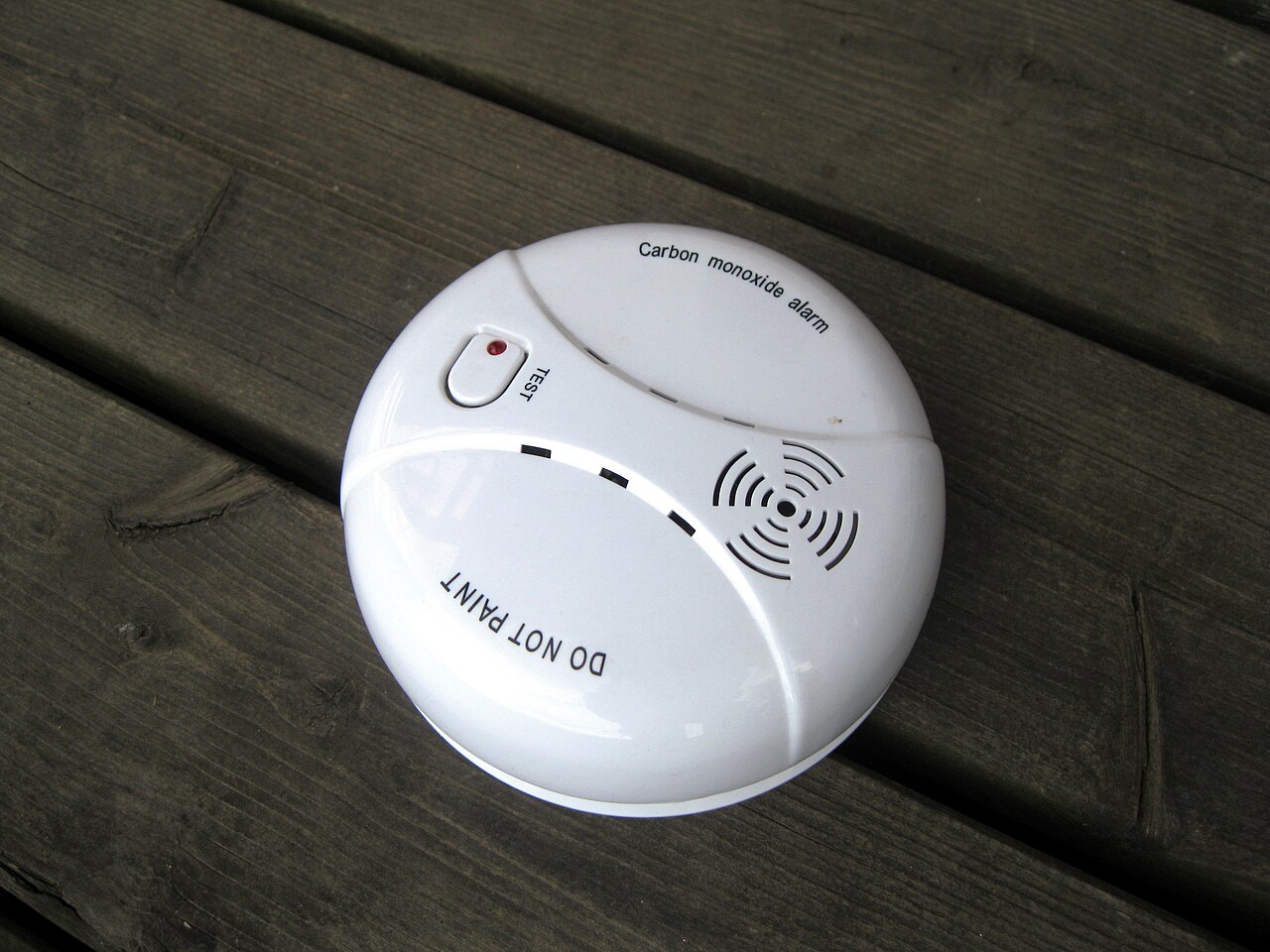
Household alarms make several different sounds. The NFPA desk reference says to know the difference between the sound of the CO alarm, the smoke alarm, and the low-battery signals. It also gives one decision rule that is easy to remember: if the audible low-battery signal sounds, replace the batteries or replace the device. If the CO alarm still sounds after that, get to a fresh air location and call 911.
The sources do not give a universal beep pattern for CO, and patterns vary by product. The product manual is the reference, and a few minutes with it at installation time beats guessing at 3 a.m. Some alarms also give an end-of-life signal. CPSC notes that newer alarms signal when the unit needs to be replaced, and NFPA says to replace the alarm according to the manufacturer’s instructions or when the end-of-life signal sounds.
| What you hear or notice | What the sources say to do |
|---|---|
| The CO alarm sounds | Go outside to fresh air, call 911 from outside, stay out until responders say it is safe (CPSC, NFPA). |
| A low-battery signal | Replace the batteries or the device. If the CO alarm still sounds afterward, go to fresh air and call 911 (NFPA). |
| An end-of-life signal | Replace the alarm (CPSC, NFPA). |
| Symptoms but no alarm | Go outside right away and call 911 (NFPA). The CDC says to exit and seek emergency medical attention. |
| The alarm fails its monthly test | Replace it (NFPA). |
Symptoms that count as an emergency
An alarm is not the only way CO announces itself. The CDC lists the most common symptoms of CO poisoning as headache, dizziness, weakness, upset stomach, vomiting, chest pain, and confusion. NFPA’s list adds drowsiness, flu-like symptoms, rapid heartbeat, shortness of breath, seizures, and loss of consciousness. CPSC separates low to moderate exposure (headache, fatigue, shortness of breath, nausea, dizziness) from high levels, where mental confusion, vomiting, loss of muscular coordination, and loss of consciousness appear.
Two points deserve attention. First, NFPA says that if more than one person in the same place has these symptoms, it may be CO poisoning, so a household where everyone has the same headache is a different situation from one person with a tension headache. Second, the CDC notes that people who are sleeping or intoxicated can die from CO poisoning without ever noticing symptoms. That is why an alarm outside the bedrooms matters more than any checklist of symptoms.
If you have any of the symptoms, NFPA’s instruction is to go outside right away and call 911. Do not wait to see whether you feel better indoors.
Where the gas usually comes from
NFPA explains that CO cannot be seen, tasted, or smelled. Its list of sources is concrete: vehicles idling in garages, and malfunctioning water heaters, clothes dryers, furnaces, cooking appliances, and portable generators. The CDC adds that generators, grills, and other gasoline, propane, or charcoal-burning devices should never be used inside the home, garage, or carport.
Knowing the list helps you tell responders what was running when the alarm went off. It does not replace the instruction to stay out. The point is to make the follow-up useful.
After the house is cleared
Responders declaring the house safe ends the emergency, but not the problem. An alarm that sounded had a reason. NFPA recommends an annual inspection of gas appliances by technicians who use combustion analyzers, and the CDC likewise says to have heating systems serviced by a qualified technician each year. If the alarm went off, ask the responders what they found and have the equipment they point to inspected before it runs again.
Then look at the alarms themselves. NFPA says to test CO alarms at least once a month and to replace any that fail the test. If you rely on battery backup, remember that a power failure is exactly when people start running generators and other fuel-burning equipment. Our piece on what happens to an alarm system when the power goes out covers the burglar-alarm side of that question, and the same logic applies to any device that depends on household power.
Alarm placement, briefly
CPSC says to install battery-operated CO alarms, or CO alarms with battery backup, on every level of the home and outside sleeping areas, and that interconnected alarms are best because when one sounds they all sound. NFPA adds that alarms belong in every sleeping room, outside each separate sleeping area, and on every level including the basement, following the manufacturer’s placement instructions. CO alarms and smoke alarms are not substitutes for each other.
Our take
Treat every CO alarm as real until emergency responders say otherwise, and do the first two steps without debate: outside, then 911. The low-battery case is the only branch where the sources allow a moment of checking, and even there, an alarm that keeps sounding after a battery swap means fresh air and a call. Write the plan on a card near the front door so every adult in the home knows it.
Common questions about carbon monoxide alarms
Should I open the windows before I leave?
The CPSC and NFPA instructions do not include it. Both say to get outside to fresh air, call 911, and stay out until responders say it is safe.
Can I go back inside once the alarm stops?
No. CPSC says not to reenter until emergency responders have given permission, and NFPA says to stay outside until emergency personnel say it is safe.
How do I know whether it is a low battery or real CO?
Learn the signals in your alarm manual. NFPA says that for a low-battery signal you replace the batteries or the device, and that if the CO alarm still sounds you go to fresh air and call 911.
How often should I test the alarm?
NFPA says at least once a month, and to replace an alarm that fails the test or gives its end-of-life signal.
Does a smoke alarm cover carbon monoxide?
Not on its own. NFPA states that CO alarms and smoke alarms are not substitutes for each other.
Who checked this
True Security Gear does not run a test lab and does not take units apart. One half of the work is documents: manufacturer specs, certifications, and seller claims checked against the paperwork. The other half is the record owners leave behind, in verified-buyer reviews, owner forums, and warranty complaints. Where that evidence is thin we say it is thin, rather than filling the gap with an adjective. The criteria are on How we evaluate.
Google lets you pick which sites come up first in your own results.